
Refugium
"Sometimes our life reminds me of a forest," wrote Wendell Berry. The life of the early disciples —and our life as a church community—reminds me of a forest, too. A forest refugium, that is...

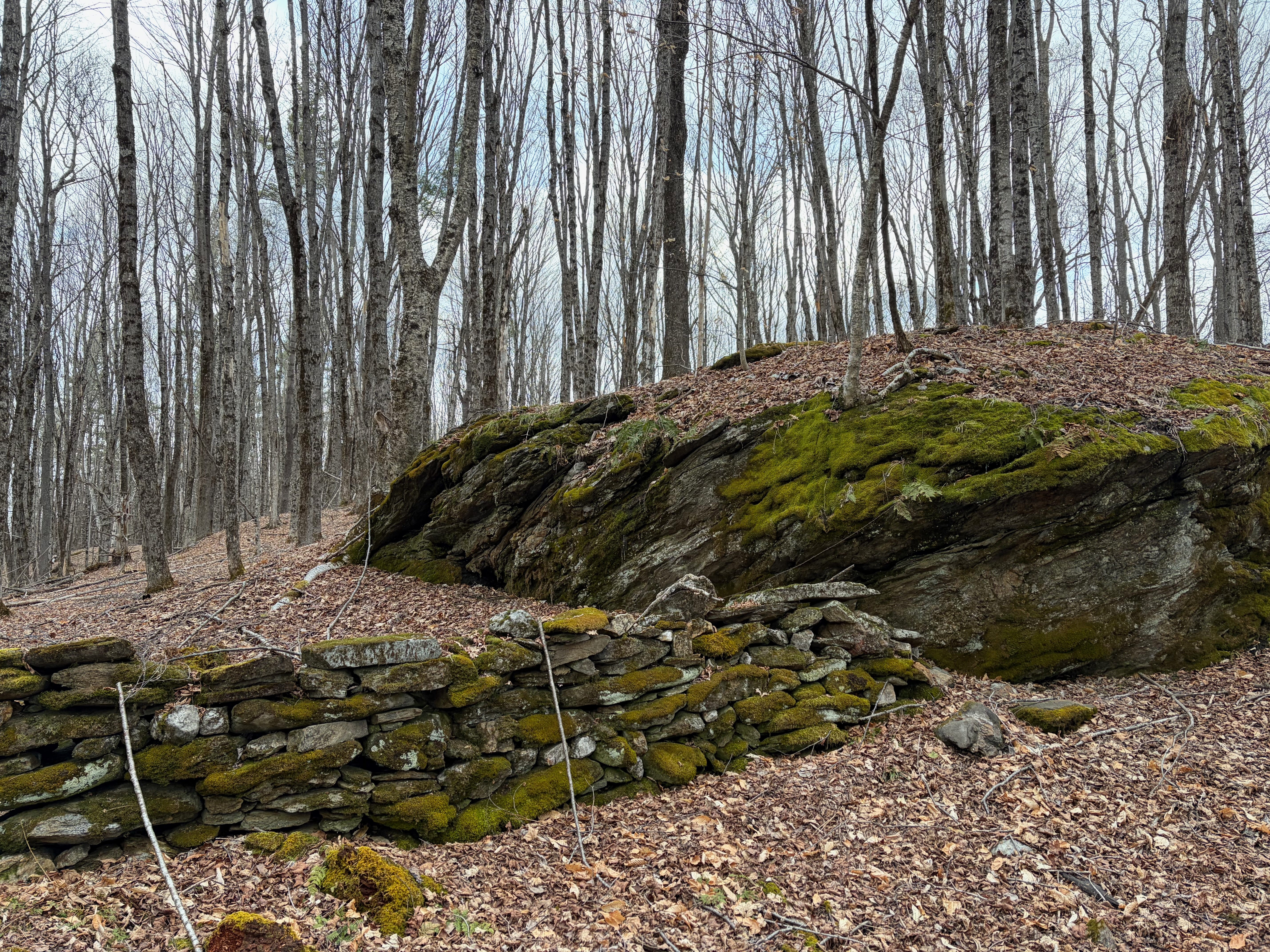
This sermon, on Acts 2:36-42 (and a little bit of Luke 24:13-43), was preached at the Church of Christ at Dartmouth College on April 19, 2026. A livestream of the service can be seen on our YouTube channel.
Early in my first semester at Dartmouth,
I went for a walk in the woods
with a new friend from southern California.
Those woods were just an average New England forest, as my eyes saw it:
mixed maples and birch, the occasional white pine,
all of it laced through with moss-covered stone walls.
We’d been walking for awhile
when my friend stopped next to one of those walls,
looking perplexed.
“What’s up with all these walls?”, she asked.
“Why do New Englanders build walls in their forests?”
“They don’t,” I told her.
“The forests didn’t used to be forests.”
“This was a field before the forests grew back.”
I had taken the history inscribed
in New England’s ubiquitous stone walls for granted,
and I still remember the rush of delight I felt
as I saw that familiar landscape through new eyes —
through her eyes.
This was a field before the forest grew back.
The forest grew back.
New Hampshire and Vermont are currently
the 2nd and 4th most forested states in the country:
80% and 76% covered by trees, respectively.
But had my friend and I been out walking 100 years earlier,
we would have been walking through a world of fields —
a world of eroding topsoil and diminished forests.
These most-forested states in the country
were mostly deforested for awhile there.
Mostly deforested.
Mostly
because even at peak deforestation,
small patches of forest remained.
In woodlots and sugarbushes,
in valleys too steep to farm
and on mountainsides too remote to log.
Forest refugia persisted.
Places of refuge.
For forests and all who dwell within them.
And so, when the pastures were abandoned,
when the agricultural center of gravity moved west to less stony ground,
forest species spread from those places of refuge.
Within a mere handful of decades,
a mostly deforested landscape of mostly fields
became, again, a place of forests,
“lovely, dark, and deep.”[i]
“America’s most hopeful landscape,”[ii] Bill McKibben called it.
It feels a little bit like a miracle.
But it’s not.
It’s what biological refugia do:
they foster resilience,
they nurture the capacity for regrowth.
Refugia are places of shelter
in which life can endure,
from which life can emerge and rebuild.
__
And in a way, the early Christian communities
that we see forming at the end of Luke’s Gospel
and in the passage from Acts
feel a little bit like that.
In those early days,
the landscape looked bleak
for the followers of Jesus.
The Roman Empire’s grip was undiminished.
The folks in charge thought they had solved the Jesus problem.
And most everyone else probably thought that, too.
But in the shelter of that table in Emmaus,
in the safety of that room in Jerusalem,
a different truth was taking hold,
a different kind of community was emerging.
A community gathered around the risen Christ.
A community of participants in his risen life.
And in the passage we heard from the book of Acts,
Peter, a few weeks after that first Easter,
extends an invitation into that community
to everyone within earshot.
That passage allows us to listen in to the very end
of Peter’s first-ever sermon, preached on the street
to a crowd of pilgrims who had come to Jerusalem
for the Feast of Weeks, a harvest celebration
that happens fifty days after Passover.
(It’s the day we’ll celebrate a few weeks hence
as the day of Pentecost.)
Filled with the Holy Spirit,
Peter proclaims to the gathered crowd
that Jesus who was crucified is raised,
that Jesus who was crucified is Lord and Messiah.
It is God’s doing, Peter tells them.
And as the book of Acts describes it,
those listening are cut to the heart at those words —
they feel this news in their inmost being.
“What are we to do?” they ask,
the question full of longing,
full of the need for a second chance
that I’m guessing all of us have known.
And Peter — Peter who thrice-denied Jesus,
Peter who was then forgiven and embraced by Jesus —
Peter surely recognized the longing in that question.
And he says, repent:
repent, be baptized, and save yourselves
from this corrupt generation.
Peter’s words are an invitation
into a different way of being —
an invitation to be transformed
by what we meet in Christ.
Repent:
change your heart, change your mind,
that word means.
Be baptized:
an outward sign of an inner transformation—
of a heart turned toward Christ,
of a life transformed in Christ.
And finally, save yourself:
be healed, is what that word “save” means —
be made whole in these fractured, troubled, corrupt times.
Change.
Be transformed.
Be made whole.
Come on in.
That’s what Peter said
to the crowd of people with the longing
in their hearts.
__
And none of that should be heard
as anti-Jewish in any way.
Judaism was the faith of Peter’s birth,
and the faith that he and the other disciples still claimed.
Peter’s call to join the Jesus movement
was a rejection NOT of Judaism
but of a society that had lost its way
and drifted from its faith moorings.
There amid the violence and greed of Empire,
Peter invited people in to the shelter
of a new kind of community.
A community gathered around the risen Christ.
A community of participants in his risen life.
A community in which the goodness they encountered
in Christ could be nurtured and grow
and spread.
A community of people who chose to live
differently. in a corrupt and broken world.
A community that was, in other words,
a counterculture.
A refugium for a different way
of being human in the world.
Those are the roots of the Church.
Those are our roots.
And it might be time to return to those roots.
__
A few years ago, a theologian named Debra Rienstra
made the case for exactly that
in a book called Refugial Faith.
Refugial faith, as she described it, is the practice
by which people of faith find and create places of refuge:
pockets of faithful counterculture,
in our communities and in our own spirits.
She drew the idea from biological refugia —
those places on the landscape, hidden and small,
where life endures and resilience is held
and the capacity for new growth is nurtured.
In a similar way, she says, a refugial faith “seeks out
whatever life-giving, kingdom-promising elements
persist [in times of turmoil and trouble]
and strives to nurture them.”[iii]
Just as a patch of forest in a deforested land
provides refuge for forest-dwelling creatures,
so a refugial faith provides refuge
for the ways of love and mercy, compassion and justice,
in times when cruelty and greed have the upper hand.[iv]
And that sounds like the kind of faith
we need in these times.
__
Part of the challenge of living
in the here and the now
is that what’s wrong feels
so big, so thoroughly beyond our grasp.
To feel helpless is understandable.
To wonder what we can possibly do
that will do any good at all
is perfectly reasonable.
But the practice of refugial faith
anchors us in a resurrection faith
that was born in the shadow of death
and in the grip of an Empire that thought it had won.
It reminds us that God has always worked
through the small and the hidden,
the unlikely and the powerless.
So, no, we can’t change the world —
not in one fell swoop, at any rate —
but we can learn to be a place of refuge
within it.
A community of refuge.
A community that participates in Christ’s risen life
by nurturing in the here and in the now
what is beautiful and good and life-giving
that it might grow and spread.[v]
A countercultural community that carries the ways
of justice and mercy, love and compassion
through these wilderness times
and to the whole kinship of humanity and of all creation.[vi]
__
To live a refugial faith
is to let our faith moor us
in turbulent times.
To live a refugial faith
is not to retreat from the world
but to create a life together that offers shelter in the world.
It is to choose
to not conform,
to not comply,
and to not wait for the world
but to live in the now and in the here
the lives we believe in.
Which is, after all,
is what hope, lived out loud,
looks like.[vii]
May it be so.
To Christ be all thanks and praise.
Amen.
[i] Robert Frost, “Stopping by Woods on a Snowy Evening”
[ii] Bill McKibben, Wandering Home: A Long Walk Across America’s Most Hopeful Landscape, 2005.
[iii] Debra Rienstra, Refugial Faith, 92
[iv] ibid, 43, adapted
[v] ibid, 5
[vi] ibid, 43, adapted
[vii] ibid, 223, adapted